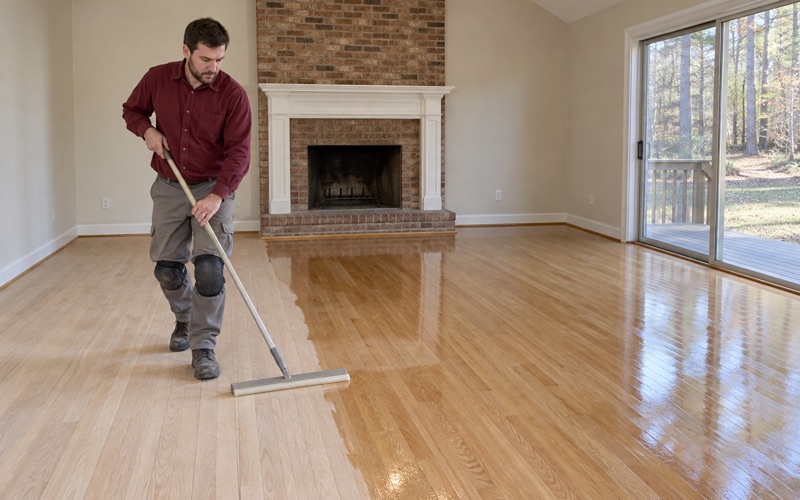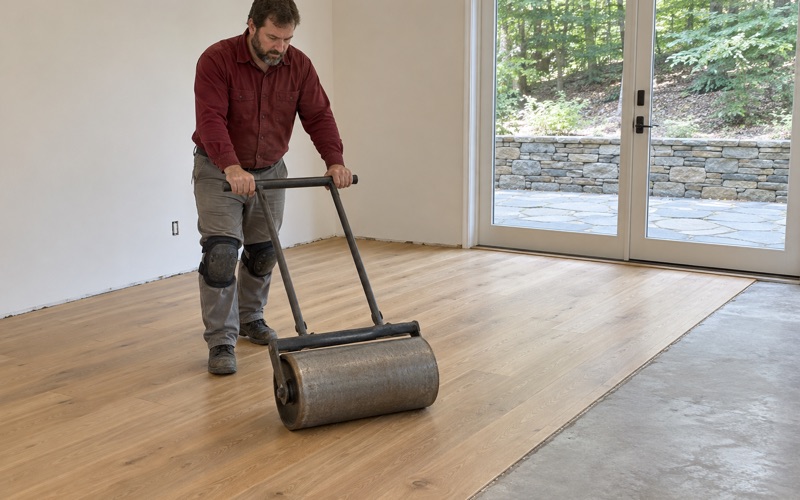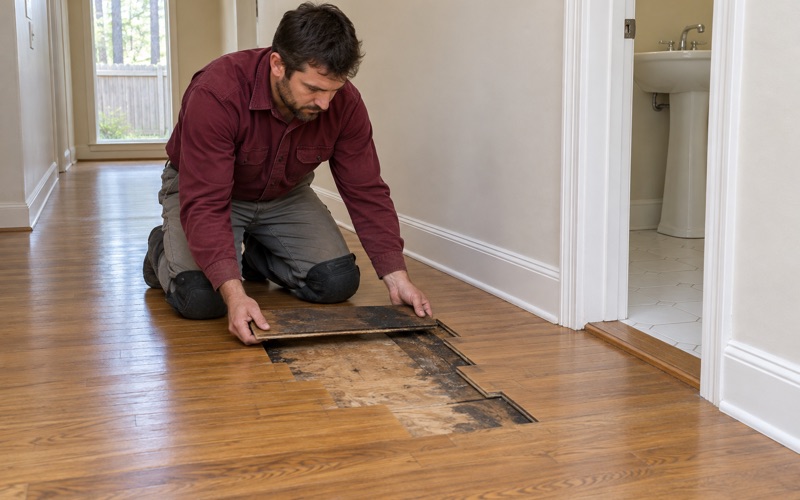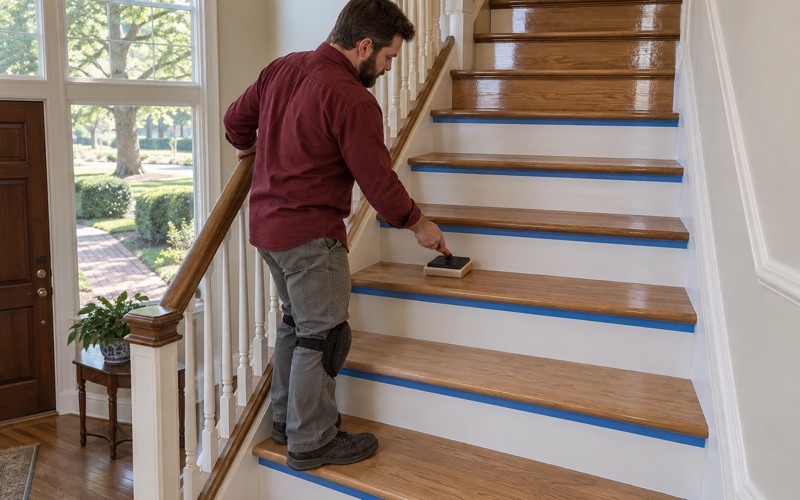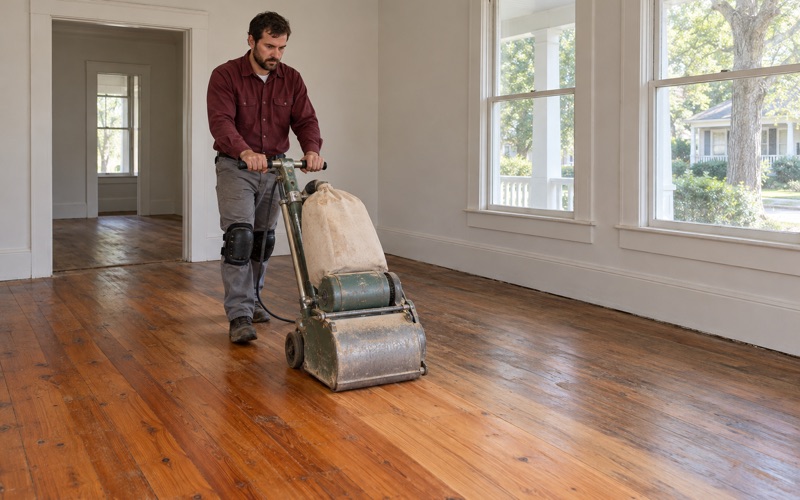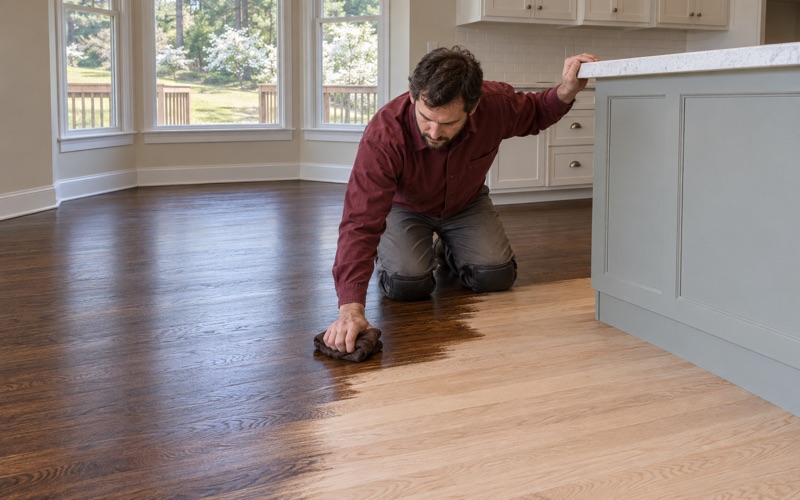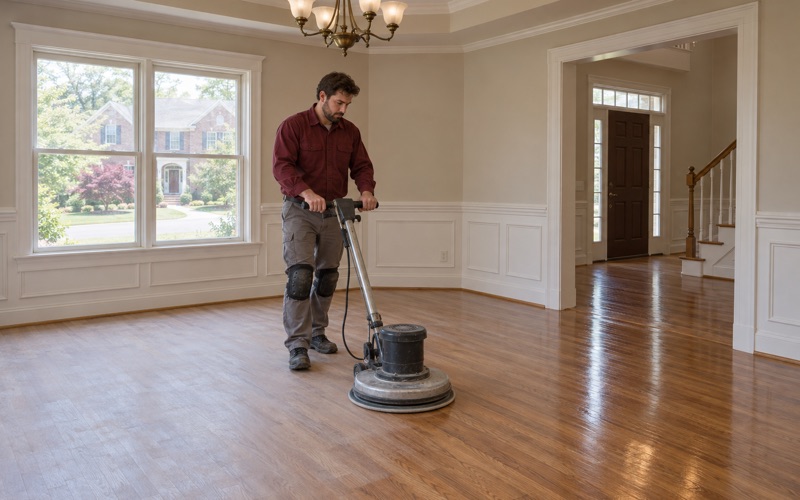
Roswell Wood Flooring handles wood-flooring in Chamblee with more than 20 years of work behind us, and most of the calls we take start with a board that changed shape. A strip of oak that has cupped along a wall, a clammy feel underfoot after a wet week, a soft spot near a back door: we read each of those with a moisture meter and find where the water came from before we quote any sanding.
That order matters because sanding a cupped floor flat while it is still wet leaves it crowned once it dries, and screwing down a spongy area hides the problem rather than fixing it. We would rather open the floor, trace the moisture to the subfloor or whatever sits behind it, and give you a repair plan that addresses the cause as well as the boards.
Our work here covers refinishing, board replacement, stairs and new hardwood, from site-finished oak to engineered planks on slabs. The thread running through most of it is water, and in Chamblee that water often starts outside, on the lot itself. Knowing who is responsible for that drainage shapes what a lasting floor repair looks like.
A City That Drains Two Ways
Nancy Creek in the North, North Fork Peachtree in the South
The City of Chamblee describes itself as made up of two watersheds, Nancy Creek and North Fork Peachtree Creek. Its stormwater program puts the split plainly: in the north part of the city, stormwater drains to Nancy Creek, and in the south it drains to the North Fork of Peachtree Creek. Every roof, driveway and backyard slope in town sends its rain one way or the other.
Neither creek is a pristine stream. Each has a tributary, Bubbling Creek feeding Nancy Creek and Arrow Creek feeding the North Fork, and the Georgia Environmental Protection Division has designated all four as impaired due to urban runoff. That label says something about how much water moves across paved and built ground here before it ever reaches a channel.
How Much Rain Runs Off
The city’s resident guide estimates that 30 to 55 percent of stormwater becomes runoff in areas with medium and high density development, and it names Chamblee as one of those areas. Rain that cannot soak in has to go somewhere, and on a tight lot that somewhere can be the side of a house, a patio door threshold or a low corner of the yard.
On the floor side, runoff matters most where it collects. A downspout that empties beside an exterior wall, a patio that pitches toward the house, or a yard graded toward a back door can keep the lowest boards in a room damp long after the rain stops. Those are the details we look for outside before we recommend anything inside.
The city’s stormwater program also notes that heavier runoff in a big storm can cause street flooding and erode stream banks. We are not in a position to say which blocks see that, and we will not guess. What we can do is look at the house in front of us, see where its own water goes, and measure what the floor is holding.
A Citywide Survey Underway
Chamblee is currently carrying out a citywide stormwater system survey and assessment to prioritize and budget future improvement projects and build a master plan. That work is about public infrastructure over years. It does not change what happens on your lot this season, which is why we treat drainage at the house as its own question when a floor starts to move.
Looking for wood-flooring closer to Holly Springs? See Wood-Flooring Services in Holly Springs.
Whose Drainage Is It: City Pipes and Private Systems
What the City Maintains
The resident guide draws a clear line. The city maintains infrastructure on city-owned property, inlets and pipes completely within the right-of-way of city-maintained roads, and pipes running from that right-of-way to the first structure on private property where a drainage easement exists. That first structure might be a junction, a headwall or an inlet.
If you are not sure whether an easement crosses your lot, that is a question for your closing documents or the city, not for us. We mention it because it helps decide who fixes a clogged or broken pipe, and a pipe backing up near the house is one of the ways yard water ends up against a wall with a floor on the other side.
In practice, our part is narrower than the city’s or yours. We can show you where water is entering, which wall it favors and how far it has traveled under the floor. Whether the fix outside is a request to the city, an HOA request or a call to a drainage contractor depends on where that line falls.
Everything Else Is Private
Anything the city does not maintain is, in the guide’s words, a private system that must be maintained by the property owner, the homeowners association or another governmental entity. Downspout lines, yard drains and swales on your own lot, where no easement applies, generally sit on that side. In a townhome or condo community, the association may own the pieces a single owner cannot reach.
That matters in Chamblee because 21.8 percent of owner households live in one-unit attached homes. If you own a townhome and your floor has taken on water, we will ask early whether the drainage outside belongs to you or the association, and we will confirm your HOA’s written approval before any flooring work begins, since any interior flooring rule comes from your own declaration.
Sewer Is a Separate System
One more distinction is worth knowing. Chamblee’s sanitary sewer is owned and operated by DeKalb County and is separate from the city’s stormwater system. A backup from a floor drain or a toilet is a different problem from rain running off a neighbor’s slope, handled by different people, and it calls for a different cleanup before we touch a board.
When Yard Water Becomes a Floor Problem
What We See on the Floor
Water that reaches a house from its own lot rarely announces itself as a leak. It shows up as cupping along an exterior wall, boards gapping and then tightening with the weather, a musty smell under a rug, or a hollow spot near a patio door. Left long enough, boards can buckle, and mold can grow under hardwood where nobody sees it.
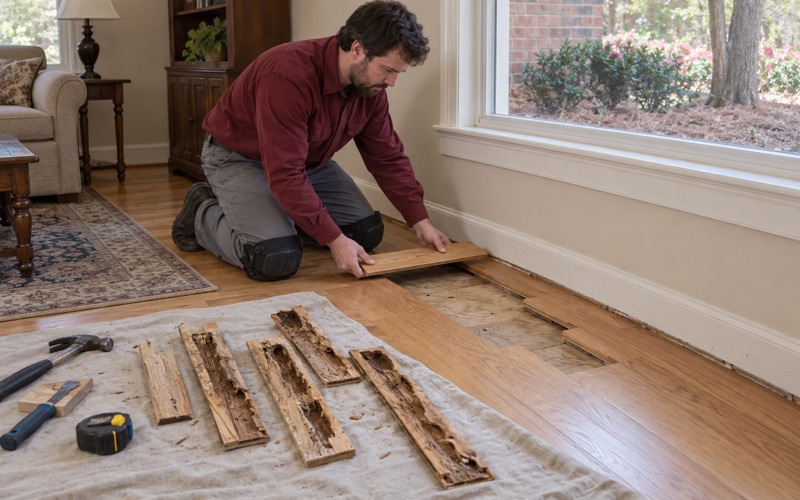
Termite trouble can look similar at first, since subterranean termites favor damp wood. If we find mud tubes or damaged boards, the pest control company treats first, and then we cut out the damage and weave in matching stock rather than filling or covering it. Sellers facing a termite letter before a closing date can call us for the same work.
Moisture Checks Before Refinishing
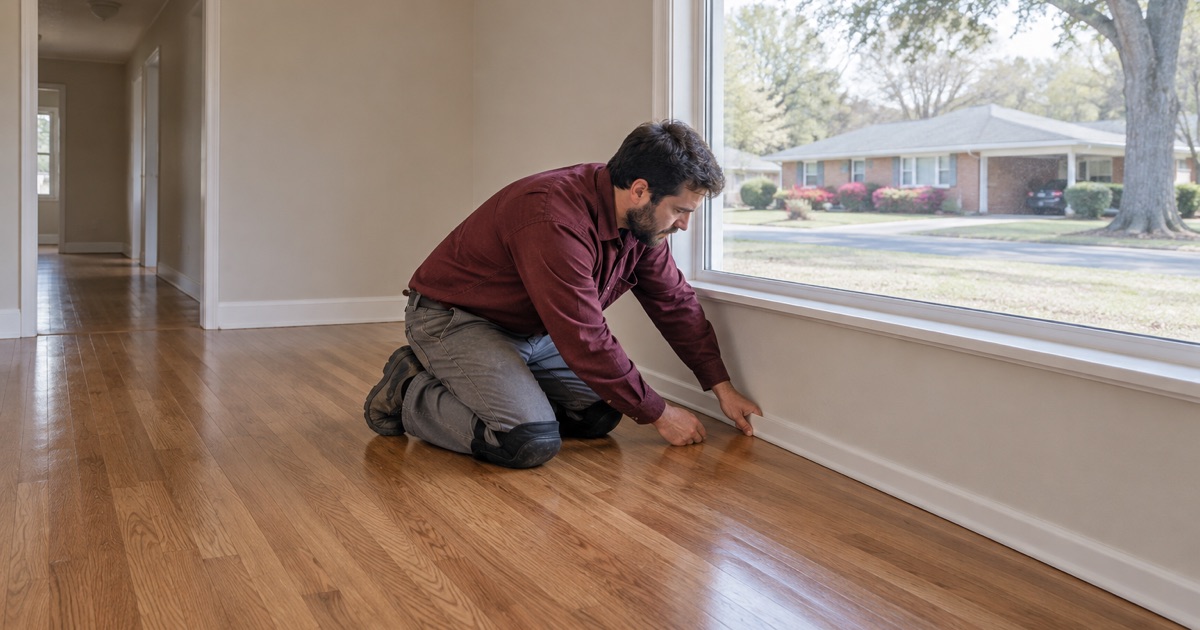
Before we refinish or replace a floor in Chamblee, we take moisture meter readings across the room and compare the boards near exterior walls and doors with those in the middle of the house. A floor that reads wet at one edge points to a source outside or below, not in the finish, and sanding it now would only lock in the problem.
Drying comes first, with a dehumidifier and time, and then we measure again. When the readings near the wall settle and match the rest of the house, sanding and refinishing can go ahead. If they climb again after the next heavy rain, the source is still active, and we would rather tell you that than put a new finish over it.
Documenting for the Adjuster
When water from a storm, a washer, a dishwasher or a supply line has reached the floor, we trace it, dry it and record readings room by room so an adjuster has something concrete to work from. That record also helps you separate what came from inside the house from what came off the lot.
We should be honest about the limits here. Sorting out a downspout or a yard drain is often worth doing, but it is not a guarantee that a floor will never move again, and we do not promise that. What we promise is that we will not sand, stain or replace boards over moisture we have not measured.
Floors in Chamblee’s 1960s Houses and Newer Homes
The 1960s Stock
Census estimates for Chamblee count 13,743 housing units, and the 1960s are the largest single build decade, at 19.0 percent of the total. Nearly half the housing, 46.9 percent, predates 1980. The city’s footprint has grown too: it annexed Huntley Hills in 2010 and Beverly Hills and Beverly Woods in 2013.
In a house of that age, we check the build year and any painted surfaces before sanding, since older paint on trim, thresholds or stair risers can change how the work has to be done. We also look at how much wood remains above the tongue on any floor that has been sanded before, because a floor refinished several times may not have another full sanding left.
Whatever species a 1960s floor turns out to be, we refinish it for what it is. Red oak and white oak take stain differently, and an older floor carries a patina a catalog sample cannot match, so any new boards woven in are matched to your floor’s color. Stain samples go down on your own floor, in your own light, before you choose.
For finish, we talk through waterborne polyurethane, oil-modified polyurethane and hardwax oil, along with sheen level, because each wears and repairs differently. On a floor near an exterior door that has already seen water, a finish that can be spot-repaired later is often worth the conversation.
Homes Built Since 2000
Chamblee also has a large newer stock: 35.4 percent of its housing units date from 2000 or later, including 2,062 built in the 2010s and 500 since 2020. In newer houses and townhomes we often find builder-grade floors, carpet on the stairs and landings, or engineered planks on the ground level.
Replacing carpet with hardwood means pulling the pad and tack strip, checking the subfloor, and deciding between solid and engineered wood for each level. Solid hardwood does not belong below grade, so on a slab or in a lower level we match an engineered product with an adequate wear layer, and we check moisture there first for the same reasons.
Stairs and Rental Houses
Stairs are quoted tread by tread, with refinishing existing treads and installing new ones priced as the separate jobs they are. Two-story landings get the same attention as the rooms they connect, so the nosing, risers and reducers read as one floor from the foyer up.
Roughly 60 percent of Chamblee households rent, and about one in five occupied detached houses is rented. If you own a rental, the drainage question from earlier still applies, since a private system is the owner’s to keep up, and a documented moisture reading between tenants is a simple way to catch a floor problem before it spreads.
- 20+ Years on Wood Floors
- Moisture Read Before Sanding
- Stain Samples on Your Floor