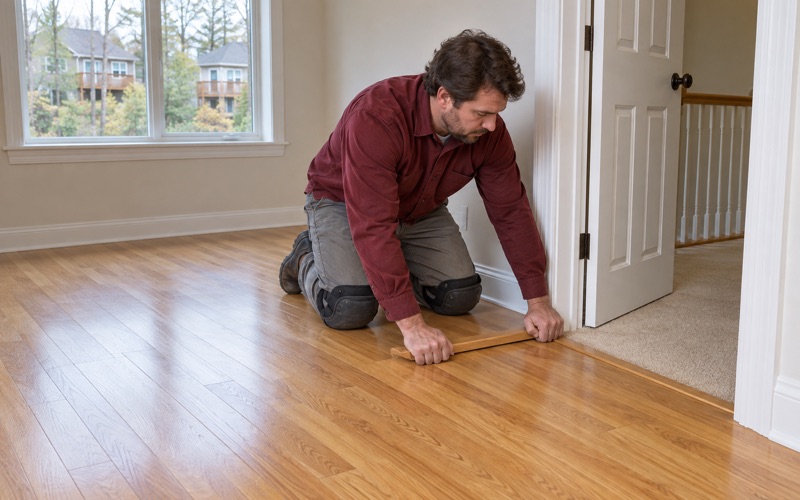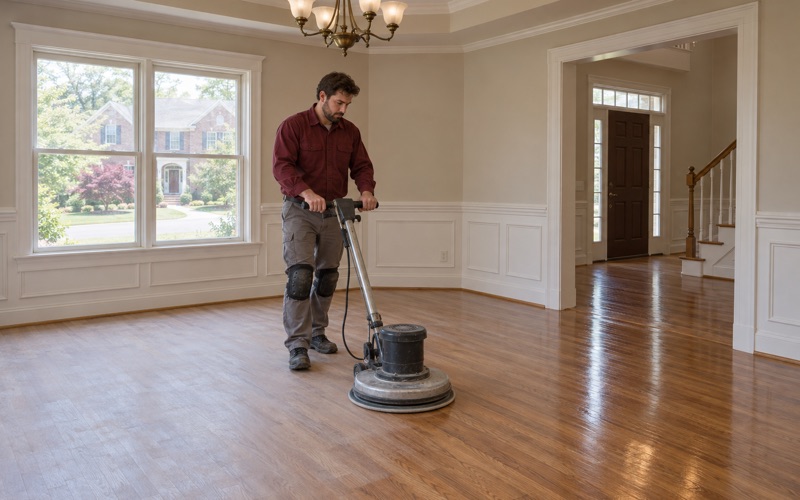
Roswell Wood Flooring handles wood-flooring in Duluth for apartment owners, townhome landlords and property managers who need floors repaired on a schedule, and we have been doing this work for more than 20 years. Most of what we do here is not a showpiece refinish. It is a run of board replacements, sanded traffic lanes and stair repairs fitted between one lease and the next.
Rental floors take a particular kind of wear. Tenants move furniture in and out, pets leave urine stains near doors, and a slow leak under a dishwasher can sit unnoticed for months because nobody who lives there owns the problem. By the time a unit turns over, the soft spots, water stains and board gapping have usually been there a while.
We read each floor with a moisture meter, find where the damage started, and replace or refinish only what the unit needs. We also know that in this city a rental floor is not just a turnover item. It sits inside a rolling city inspection program, and that changes when the work makes sense.
How Duluth Inspects Its Apartment Rentals
An Ordinance Aimed at Four or More Units
On August 13, 2018, the Duluth Mayor and City Council approved a Multifamily Rental Housing Inspection Ordinance. The program applies to owners of multifamily rental dwellings or units in the city who receive income from four or more of them, and those owners must also hold an Occupational Tax Certificate. The city’s stated purpose is maintaining multifamily rental housing to a standard that prevents blight.
The first round was meant to be complete, with every covered unit inspected within a 12-month window before January 1, 2020. For an owner, that means every unit in the portfolio was due for an interior inspection in that first round, and the question now is which units come up next.
Twenty Percent of Units, Every Year
After five years had elapsed, the program shifted to regular annual inspection of 20 percent of units, and that cycle continues. A complex with 200 units should expect roughly 40 of them to be opened up for an interior inspection in any given year. At that rate, a unit that looked fine at its last visit may come up again carrying several more years of tenant wear.
That rolling schedule is why we encourage managers to treat floor repair as planned upkeep rather than a scramble. A soft spot by a patio door or a cupped strip in front of a refrigerator is easier to fix during a vacancy than in a week when the unit is already on the list.
Where Duluth’s Renters Live
The program touches a large share of the city. Census estimates from the 2024 American Community Survey put 65.9 percent of Duluth renter households in buildings of five or more units, and 43.5 percent of occupied homes here are rented. Those are the complexes and larger apartment buildings where one crew may be working in several units a month.
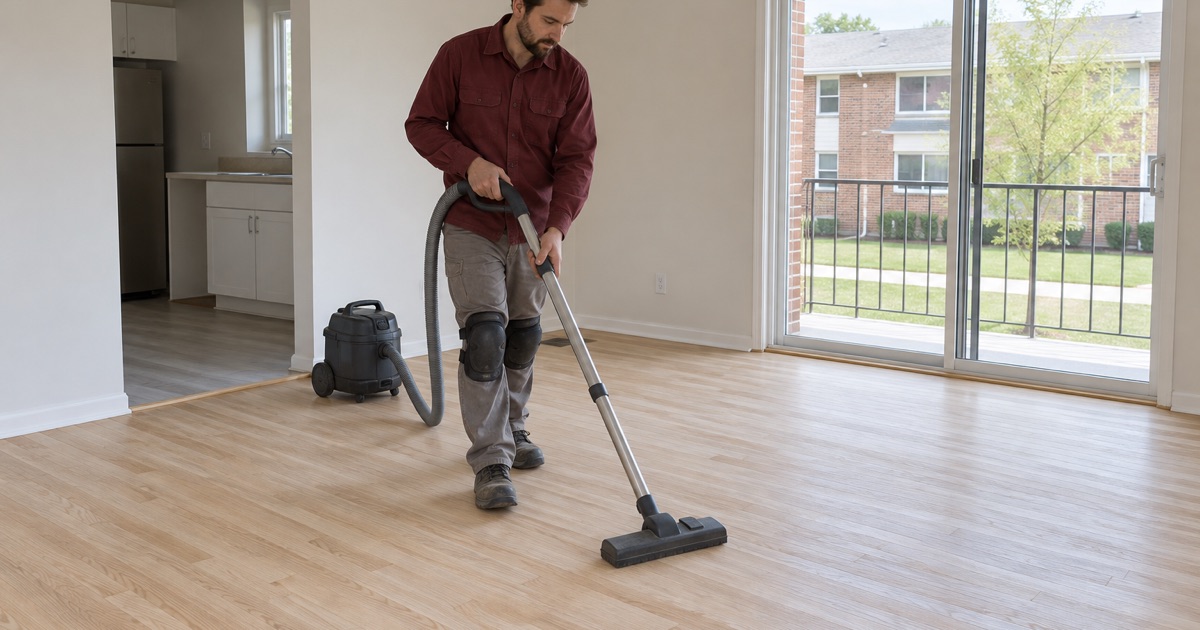
For us, that concentration shapes the work. Apartment floors see the same wear in the same places, unit after unit: the entry, the kitchen run, the path to the balcony door. We price and schedule those repairs in batches when a manager hands us a list, which keeps each unit’s downtime short.
Looking for wood-flooring closer to Brookhaven? See Wood-Flooring in Brookhaven.
What the Interior Form Says About Wood and Walking Surfaces
Decayed Wood and Defective Surface Conditions
Duluth’s Interior Inspection Report grades each unit pass or fail, code section by code section, against the International Property Maintenance Code. Under IPMC 305.3, interior surfaces must be kept in good, clean and sanitary condition, and ‘cracked or loose plaster, decayed wood and other defective surface conditions shall be corrected.’ A broader line, IPMC 305.1, requires the interior to be maintained in good repair and structurally sound.
Wood flooring is a wood surface, and the damage we see most in rentals fits that language plainly. Rot at a bathroom threshold, boards blackened by pet urine, and a strip of floor softened by a leaking supply line are the kind of conditions that language describes, even though the form never names flooring.
Peeling, chipping, flaking or abraded paint also falls under 305.3, and in a rental that can mean baseboard and quarter round next to a damaged floor. When we replace boards along a wall, we reset the quarter round and leave the trim ready for the painter rather than torn and splintered.
Stairs, Landings and Every Walking Surface
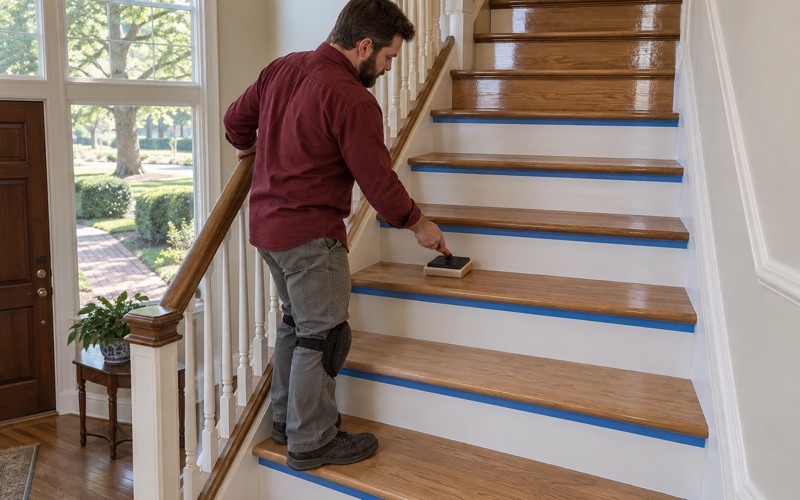
IPMC 305.4 reaches further: every stair, ramp, landing, balcony, porch, deck or other walking surface must be maintained in sound condition and good repair. In a two-story townhome rental, that puts the wood stair treads, the nosing and the landing at the top squarely in view.
A cracked tread, a loose nosing or a split board on a landing is a walking-surface problem, not a cosmetic one. We quote stairs tread by tread, and we price refinishing separately from replacing treads, because those are two different jobs with two different costs.
What the Form Leaves Out
The form has no line item for floor coverings or wood flooring specifically, and we do not pretend otherwise. Each report is signed by the city’s building inspector, who marks each code section pass or fail. Our role is narrower: we repair the floor, document what we found and what we changed, and leave the judgment to the person holding the form.
The same form checks plumbing fixtures under IPMC 504.1, which must be kept free from obstructions, leaks and defects. A leak fixed under the sink still leaves the floor beside it to deal with, and that is usually where we come in.
Floor Repairs to Handle Before a Unit Comes Up
Water Damage Traced and Dried First
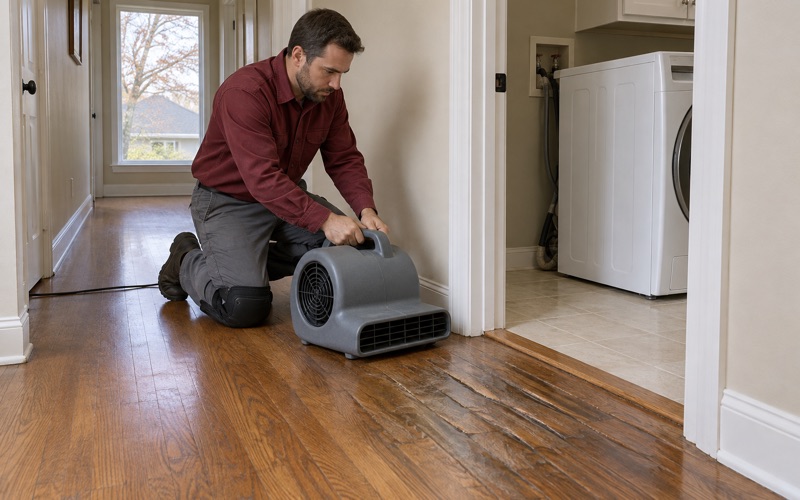
When a unit has cupping, buckling or a musty smell near the kitchen, we do not sand it flat and move on. We take moisture meter readings across the room, find the washer, dishwasher or supply line that caused it, and let the floor dry before replacing a single board. Sanding a cupped floor while it is still wet only leaves it crowned once it dries.
Georgia summers add a second moisture problem on top of leaks. A vacant unit with the air conditioning shut off can cup on its own, so we read the floor and the room before deciding whether the fix is boards or simply a dehumidifier and time.
For water losses, we document readings and damage room by room so the owner has something to hand an adjuster. In a portfolio that rotates through inspections, that record is also a clean history of what was repaired in each unit and when.
Soft Spots Opened, Not Hidden
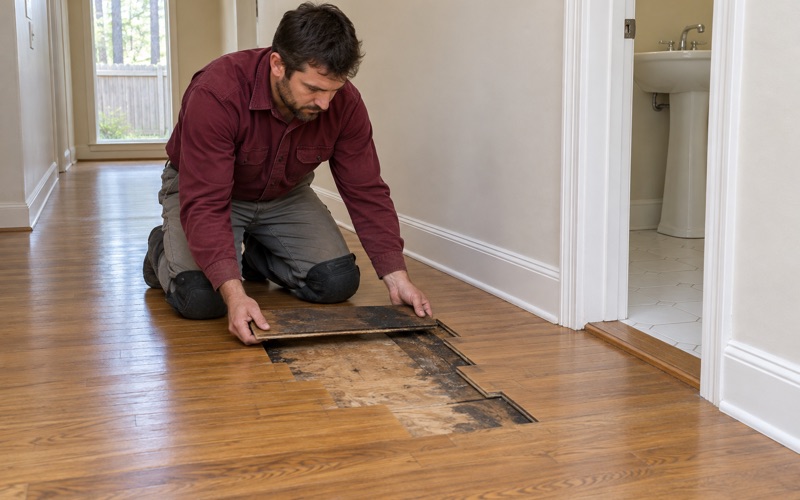
A spongy floor in a hallway is tempting to screw down and cover with a rug before a tenant moves in. We open it up instead and trace the soft spot to the subfloor, a joist or the moisture behind it. Hiding the symptom leaves the decayed wood in place, still waiting under the rug.
Soft spots in apartments cluster where water lives: beside tubs, in front of dishwashers, and at balcony doors where rain drives in under a worn threshold. Those are the areas we check first when a manager sends us a unit number and a complaint.
Boards Replaced With Matching Stock
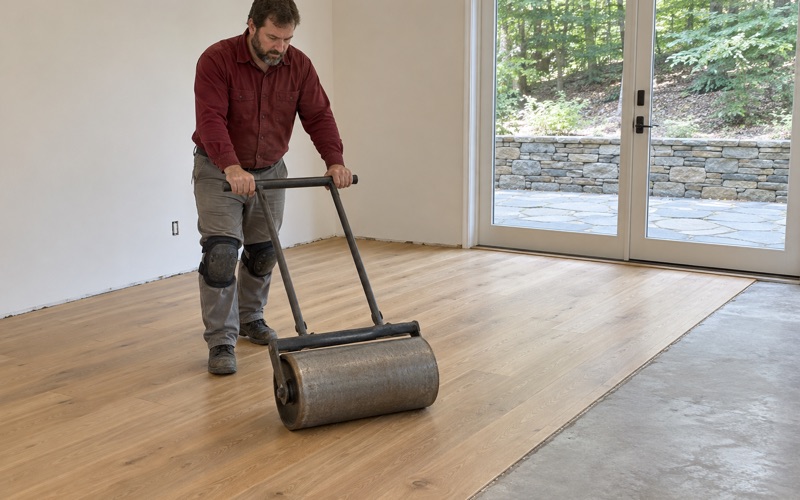
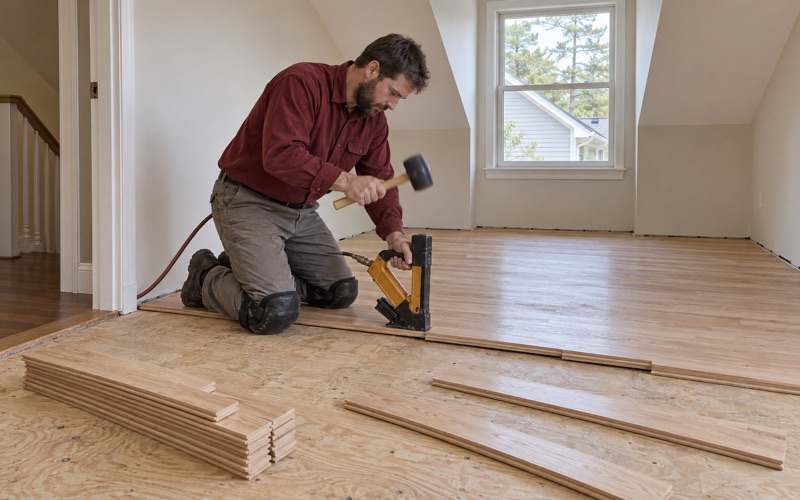
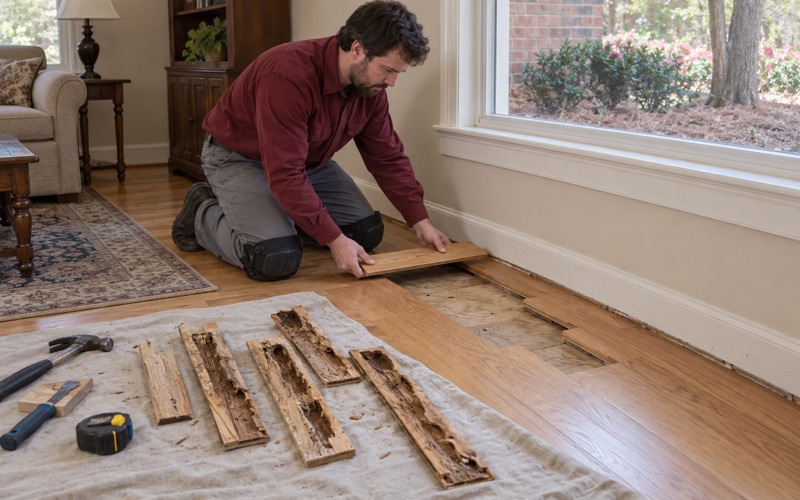
Subterranean termites, carpenter ants and old leaks all leave damaged boards that need to come out. Once the pest control company has treated, we cut the damaged boards out and weave in matching stock so the repair runs with the grain of the room. We never fill or cover termite damage and call it fixed.
In a rental, a woven repair also reads better across a traffic lane than a patch of mismatched boards. A tenant notices a patch; a matched repair tends to disappear into the floor once the room is refinished.
Renovated Units, the Grace Period and 1980s and 1990s Floors
How the Five-Year Grace Period Works
The program carries one exception worth planning around. When a newly constructed or significantly renovated multifamily rental dwelling receives a certificate of occupancy, further inspections on that unit are not required for five years. The Building Official decides whether a renovated unit qualifies for that grace period.
We are careful about what that means for flooring. New hardwood by itself is not something we can promise will count as a significant renovation, and we will not tell an owner it does. If a floor is part of a larger renovation that the owner is taking through the city, we schedule our work to fit that project and leave the qualifying question with the Building Official.
Floors in Duluth’s 1980s and 1990s Rental Stock
Duluth grew quickly alongside Gwinnett County in the 1970s and 1980s, and the housing shows it. Census estimates put 57.8 percent of the city’s homes in the 1980 to 1999 build years and only 11.8 percent before 1980. Floors from those two decades are most of what we see here.
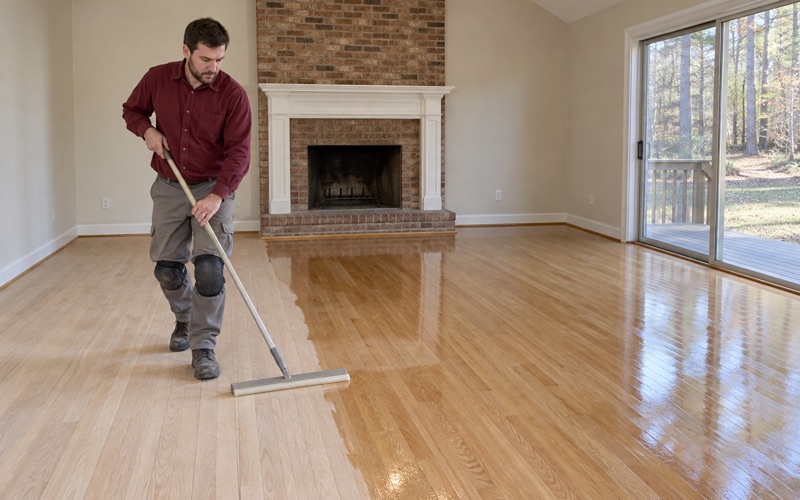
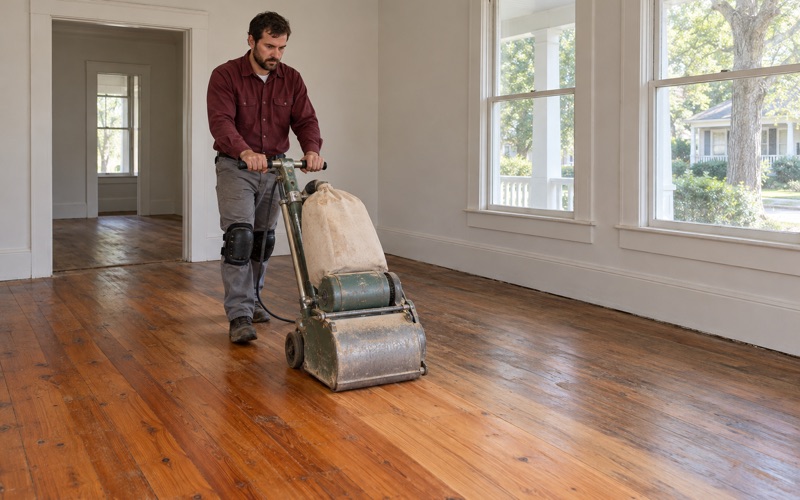
Where those units have site-finished oak that has turned orange after years under oil-modified polyurethane, we usually sand and refinish rather than tear out. Before we do, we check how much wood remains above the tongue, because a floor that has been sanded several times may not survive another full sanding.
For a unit that only shows light wear, a screen and recoat between tenants can refresh the finish without a full sand. Where builders laid carpet or parquet in the foyer, we can replace it with hardwood, stairs and two-story landings included. We also check build year and painted trim before sanding any older unit.
Townhome Owners and Smaller Portfolios
Not every floor in Duluth sits in a large complex. Census estimates put 21.2 percent of owner households in one-unit attached homes, the townhome type. In a two-story unit, the stair and landing are where wear concentrates, whether the owner lives there or rents it out.
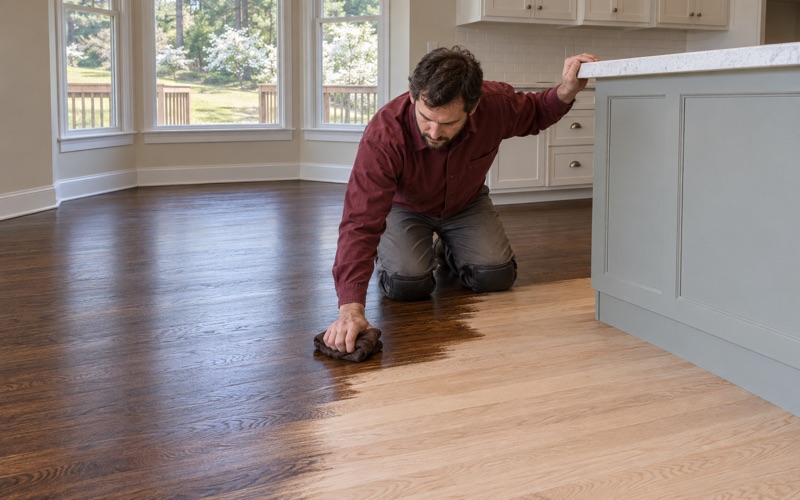
If the home sits under an HOA, we confirm the association’s written approval before starting, since any interior flooring rule comes from that community’s own declaration. Stain samples go down on the owner’s floor, in that room’s light, before anyone commits to a color.
Wherever the floor sits, the approach is the same: find the cause, repair what is actually damaged, and leave a record the owner can use. That record matters most in a city where rental units come back around for inspection year after year.
- 20+ Years on Wood Floors
- Moisture Read Before Sanding
- Stain Samples on Your Floor