Roswell Wood Flooring brings more than 20 years of wood-flooring in Kennesaw homes to a specific kind of owner: the one whose house earns its keep as a short-term rental. A guest-stay floor lives a harder life than a family floor, with new feet, new luggage and new habits arriving every few days. We plan the work around that pace instead of pretending the house sits empty for a month.
Those houses carry obligations a regular homeowner never thinks about, and a torn-up living room at the wrong moment can cost a booking, or leave a house unready when the city’s own deadlines arrive. So we start every guest-stay job by asking two questions: when is the next check-in, and where does the house stand with its license?
From there the work is ordinary flooring done with an unusual calendar: reading moisture, fixing what traffic has worn, choosing finishes that shrug off rolling bags, and sequencing rooms so a house can keep hosting. The sections below walk through the rules that shape that calendar and the floor decisions that follow from them.
How Kennesaw Licenses Guest-Stay Houses
What Counts as a Short-Term Rental
Kennesaw’s council approved its short-term rental ordinance on July 23, 2025, and licensing began October 1, 2025. The city defines a short-term rental as a dwelling unit, or a portion of one, offered to guests for lodging for less than 30 consecutive days. That under-30-day line is what separates a guest-stay house from an ordinary rental home.
Every certificate expires on December 31 and has to be renewed for the new year, so the license is an annual cycle rather than a one-time approval. The city lists a $250 application fee and a $90 inspection fee, and operators must collect and remit the 8% Hotel/Motel Excise Tax and name a 24-hour local contact.
Where Guest-Stay Houses Are Allowed
Licenses are limited to single-family residentially zoned areas, and the city capped the total at 150. Standard licenses also carry a 250-foot distance requirement between rentals and a two-property maximum per owner, so licensed houses sit apart from one another rather than side by side.
About 70 rentals already operating before 2025 were exempted from the buffer and the cap, provided they registered by December 31, 2025 with proof of prior operation and the home is owned and maintained properly by the current owner. For our purposes, this means the guest-stay houses we see sit in single-family neighborhoods, built like the family homes next door.
The Life Safety Inspection
Before a certificate is issued, every short-term rental must pass a Life Safety Inspection conducted by a City Building Inspector. We have not read that checklist, and we won’t guess at what it covers or tell you a floor job decides the outcome. That judgment belongs to the city, not to a flooring contractor.
An owner preparing for that visit has enough to manage without a flooring crew in the way. When our work overlaps an inspection date, we finish, clean up and clear our equipment beforehand rather than asking the city to work around us.
Looking for wood-flooring closer to North Druid Hills? See Wood-Flooring in North Druid Hills.
Floors That Take Suitcases and Constant Check-Ins
Traffic Lanes From the Door to the Bedrooms
Guest traffic is concentrated and repetitive. Every arrival follows the same path from the front door to the bedrooms, usually dragging a bag, and within a season that path shows up as traffic lanes: a dull gray stripe through the finish while the edges of the room still shine. Suitcase wheels carry grit, and grit under a hard wheel scratches faster than socks ever will.
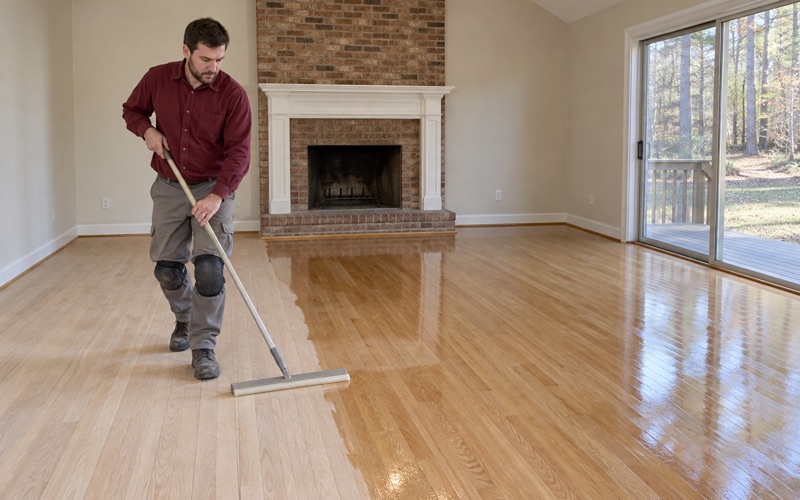
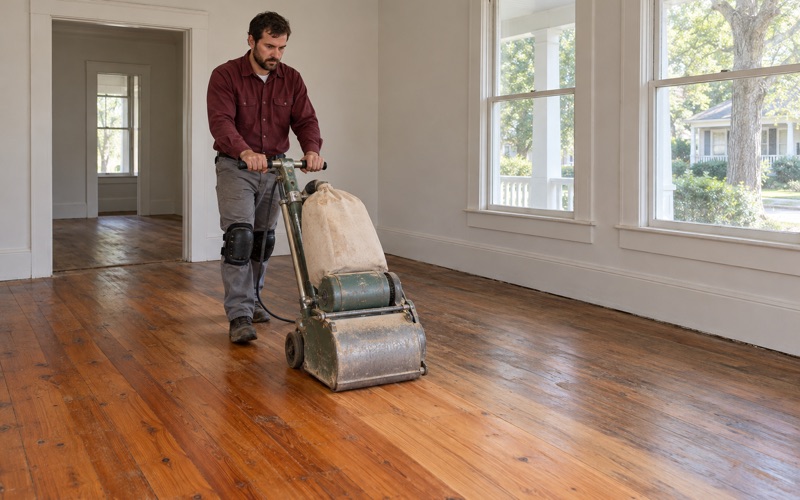
Caught early, a worn lane is often a screen and recoat job: we abrade the existing finish and add fresh coats of polyurethane without sanding to bare wood. Once the wear cuts through to the stain or the wood itself, a recoat can’t restore it, and the room needs a full sand with a proper grit sequence.
Felt pads under furniture and a walk-off mat at each entry do more for a rental floor than any finish can, and we point out where they belong during the walk-through. A luggage rack in each bedroom keeps hard-shell cases off the floor, where they would otherwise be opened in the same spot every stay.
Choosing a Finish and a Species for Turnover
For a house that turns over every few days, we lean toward hard, repairable finishes over delicate ones. Waterborne polyurethane dries fast and stays clear, which matters when the gap between checkout and check-in is short. Oil-modified polyurethane builds a warmer amber tone but needs longer to cure, so we reserve it for longer gaps in the calendar.
A lower sheen level hides the fine scratches that luggage leaves, where a high gloss shows every one under a window. If boards are being replaced or added, species matters too: white oak and hickory carry a higher Janka hardness than softer woods, and we lay stain samples on your own floor so the color works in the rooms guests actually see.
Spills, Water and Soft Spots Guests Don’t Report
Guests rarely mention the glass of water knocked over by the bed or the shower mat left soaking on the hallway floor. By the time an owner notices, the result can be water stains, cupping along the edges of boards, or a musty smell near a bathroom door.
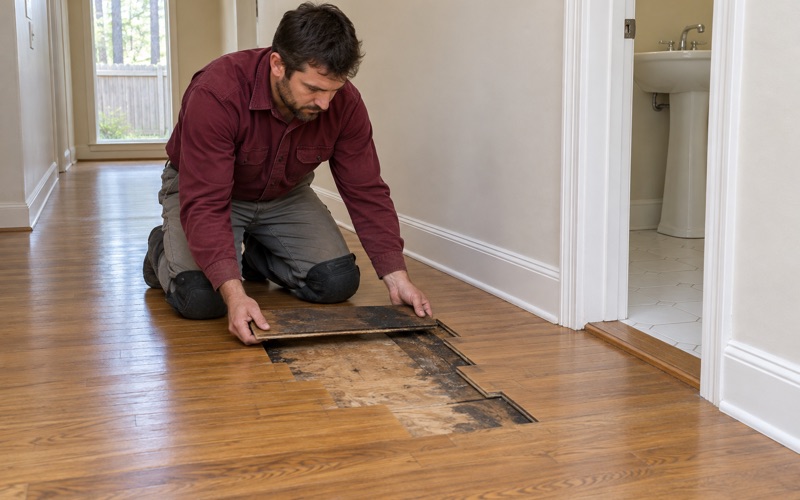
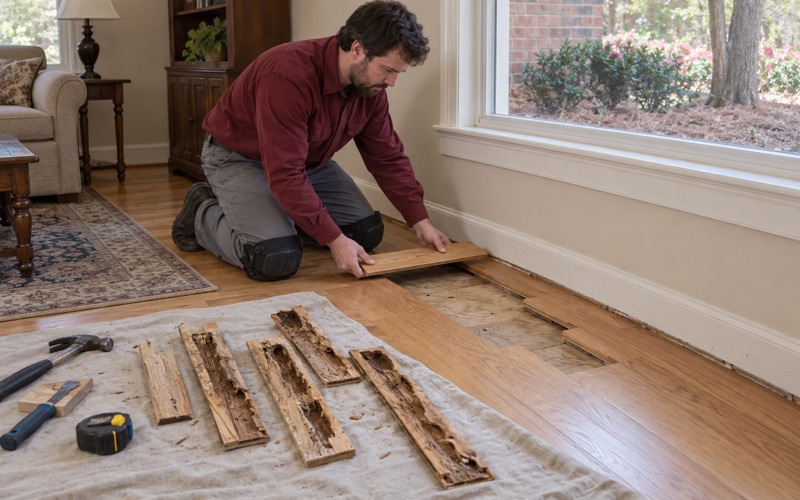
We read those areas with a moisture meter and find the source before anyone sands a cupped board flat. A soft or spongy spot gets opened up and traced to the subfloor or the moisture behind it, not screwed down and hidden under fresh finish, because a guest who finds it with a heel is the last person who should.
Scheduling Floor Work Between Bookings
Working in the Gaps of the Calendar
We ask for the booking calendar before we quote a date. A screen and recoat on one or two rooms can often fit between a checkout and the next arrival, while a full sand and refinish of the main floor needs a longer block with the house off the market. We would rather tell you that up front than squeeze a job into a window it doesn’t fit.
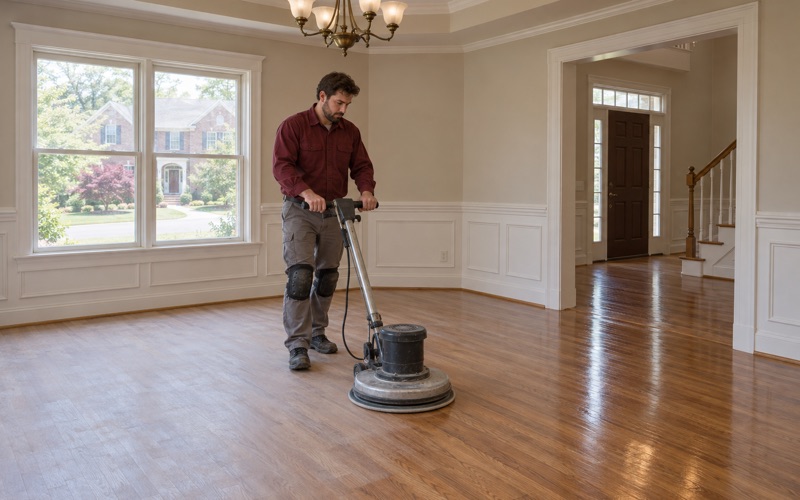
Dustless sanding keeps fine dust off the linens, mattresses and kitchen surfaces that would otherwise need a deep clean before the next guest. We also sequence rooms so finished bedrooms can be made up while the rest of the floor is still curing.
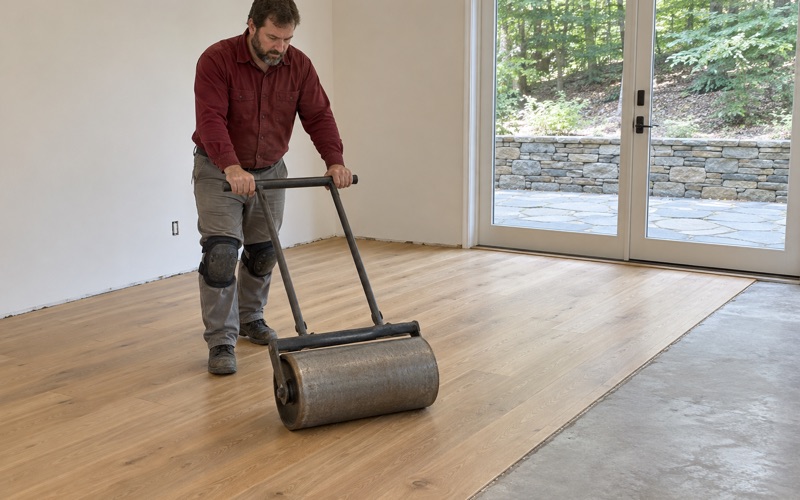
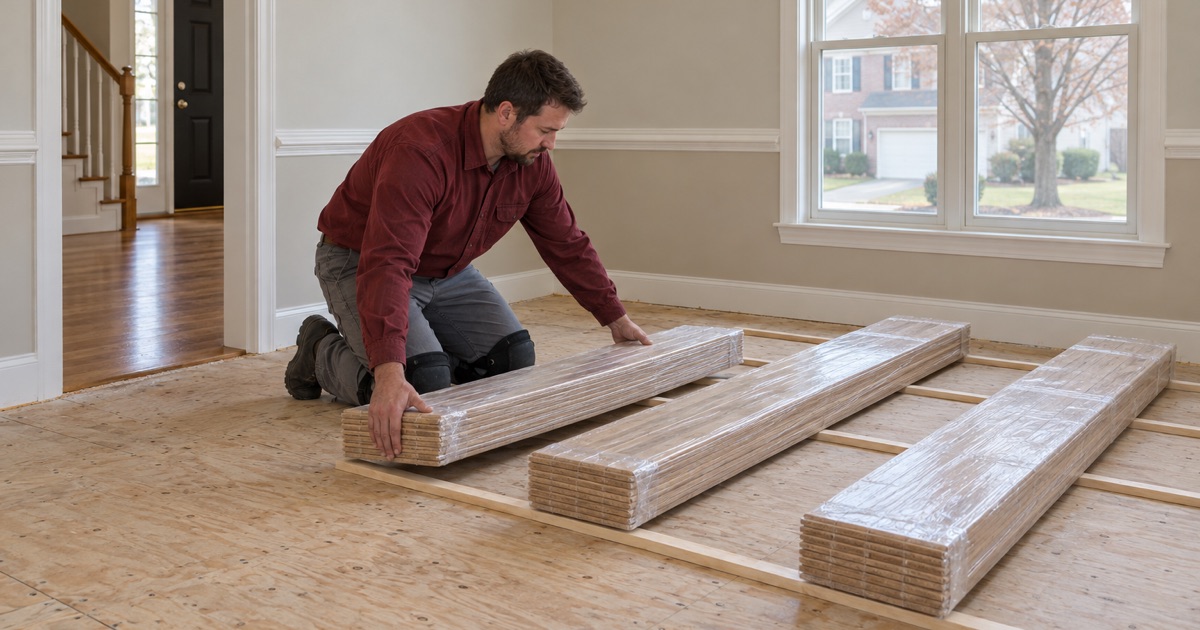
New solid hardwood also needs time to acclimate to the house before it goes down, so a replacement job starts days before the install itself. We set the boards inside with the air conditioning running as it will for guests, take moisture readings, and only then fix the install date against the calendar.
Planning Around the Year-End Renewal
Because the certificate runs out at the end of each year, December is a natural checkpoint for any owner. For bigger jobs we usually suggest one of two windows: early in the fall, well clear of the renewal paperwork, or after the new certificate is in hand.
Nobody wants to discover a lifted board or a lane worn through to bare wood the week before a full house of holiday guests. A walk-through in late summer or early fall gives us time to recoat, repair or replace boards before the booking calendar and the renewal both close in.
Keeping Records Between Stays
When water from a washer, a dishwasher or a supply line reaches the floor between stays, we trace it, dry it and measure it before replacing any board. We document the readings room by room for the adjuster, which also gives you a clear record of what happened in which booking window.
Pet-friendly listings bring one more problem that turns up between stays: pet urine stains. Surface marks may sand out, but urine that has soaked into the boards usually means cutting those boards out and weaving in matching stock, and we tell you which case you have before quoting.
Getting a House Ready Before It Is Licensed
Kennesaw’s Housing Stock
Kennesaw, known as Big Shanty until its 1887 charter, has a housing stock that is younger than its history. Census estimates put about 45 percent of its homes as built in 2000 or later, with most of the rest dating from the 1980s and 1990s, and detached houses make up the largest share.
That matters for a house about to start hosting. In homes of that age we often find site-finished oak, sometimes red oak gone orange under an aging finish, or carpet laid over the subfloor in the bedrooms. Site-finished oak from the 1980s and 1990s can usually be sanded and refinished rather than torn out, once we check how much wood remains above the tongue.
Replacing Carpet Before Guests Arrive
Carpet is a hard sell in a guest bedroom: it holds odors, shows stains between cleanings and has to be shampooed on a schedule the calendar rarely allows. We pull the carpet, pad and tack strip, check the subfloor, and install hardwood, including the stairs and any two-story landing, so the whole path from the door to the beds is one surface.
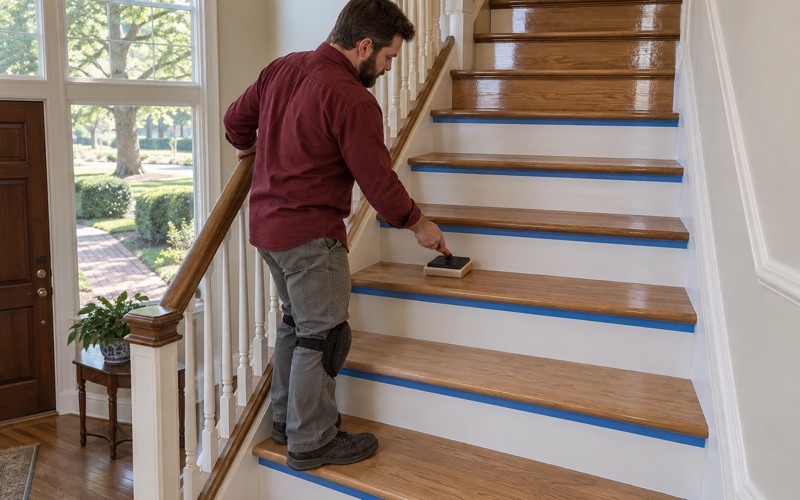
Stairs take the heaviest luggage traffic in a two-story rental. We quote them tread by tread, and we price refinishing existing treads and installing new stair treads as the two different jobs they are, so you can choose based on what the nosing and risers actually need.
Timing Floor Work Around the Application
If a house is not yet licensed, we suggest finishing floor work before the Life Safety Inspection is scheduled rather than after. That keeps the house from being shown with rooms roped off or furniture stacked in a hallway, and it means the first guest walks in on a finish that has fully cured.
If the house sits in a neighborhood with an HOA, we confirm your association’s written approval before work starts, since any interior flooring rule comes from your own declaration. In an older home, we also check the build year and any painted surfaces before sanding.
Whether the house is licensed already or still waiting on its first certificate, we start the same way: a walk-through, moisture readings, and a look at the booking calendar before any date is set. From there, the floors get planned around your guests, not the other way around.
- 20+ Years on Wood Floors
- Moisture Read Before Sanding
- Stain Samples on Your Floor