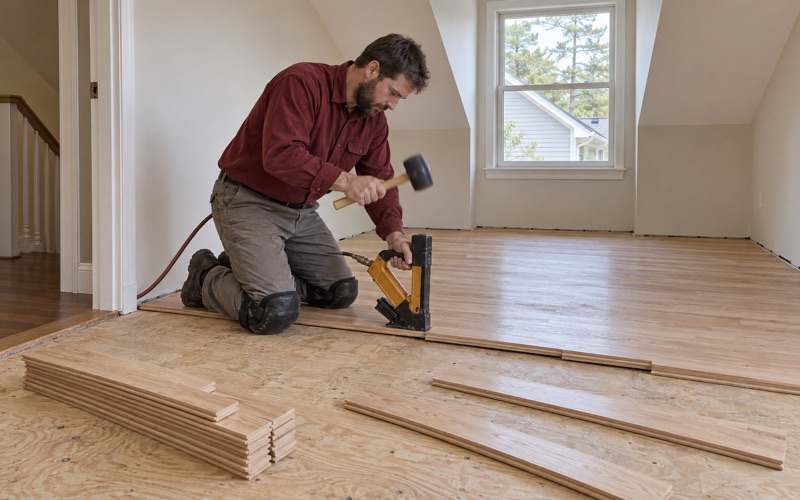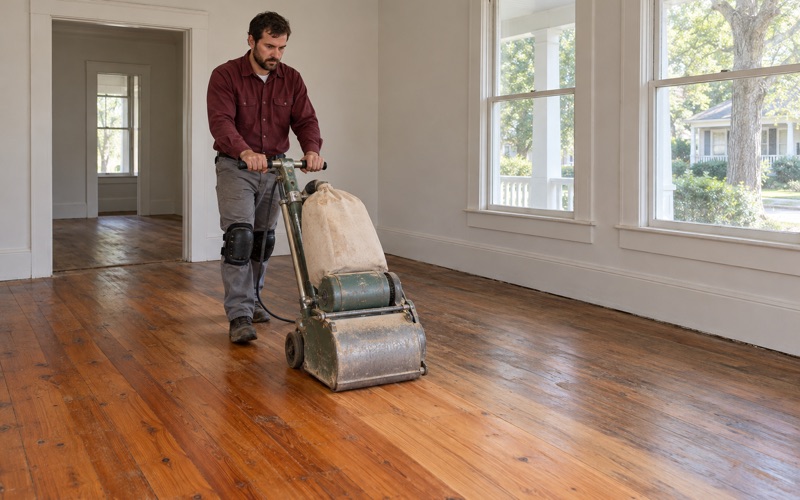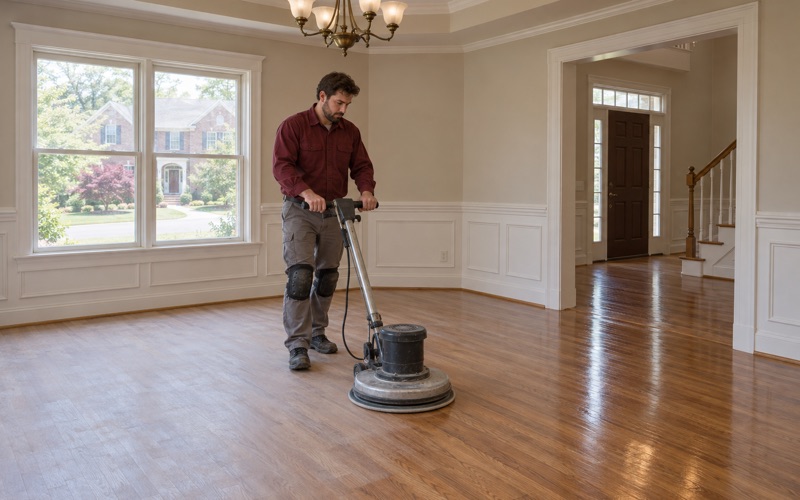
Roswell Wood Flooring has handled wood-flooring in Norcross and across this part of Georgia for more than 20 years, and the calls we get here fall into two groups. Some come from older wood-frame houses whose floors have been sanded several times already. Most come from 1980s and 1990s homes where site-finished oak has worn into traffic lanes and dulled at the doorways.
Before we quote anything, we walk the rooms. A floor that cupped over a humid summer gets read with a moisture meter, and we find the source of the water before a drum sander goes near it, because a cupped floor sanded flat while it is still wet turns crowned once it dries.
Carpet, parquet foyers and builder-grade floors can be replaced with hardwood, stairs and two-story landings included. Where a floor has water damage from a washer, a dishwasher or a storm, we trace it, dry it and measure it before any board is replaced, documenting each room for the adjuster. Whatever the age of the house, the plan starts with what the floor in front of us can take.
A Railroad Town and the Houses It Built
Where Norcross Began
Norcross owes its location to a railroad. The Richmond and Danville line was completed from Atlanta to this vicinity in June 1870, and its tracks crossed land owned by John J. Thrasher. That October, Thrasher created the community of Norcross at the end of the line, and it was chartered as a town on October 26, 1870, named for Jonathan Norcross.
Houses were built near the tracks for the people who came with the railroad. That is the oldest layer of housing in the city, and it sits beneath everything that followed: the 1980s townhomes, the subdivisions and the newer construction that make up most of the addresses we visit today.
The 1980 Historic District
The core that grew from that founding is preserved as the Norcross Historic District, entered in the National Register of Historic Places on November 21, 1980. It covers about 180 acres along Peachtree Road and the railroad, and its nomination calls it the historic core of the city as it developed from its founding in 1870 through the early twentieth century.
Its residences, the nomination says, are primarily late-nineteenth- and early-twentieth-century wood-framed structures. For floor work, that line matters more than any other in the document. A wood-frame house of that age has been through more than a century of seasonal movement, repairs, additions and refinishing, and each of those leaves a trace in the boards.
How Much of Norcross Is That Old
Not much, by count. Census figures for the city show 7,846 housing units, of which only 62 were built in 1939 or earlier, and 18.3 percent predate 1980. The busiest single decade was the 1980s. A railroad-era house is the exception here, and we treat it as one rather than handling it like the oak floor in a townhome down the road.
Even inside the district, the nomination notes that the intrusions are mostly contemporary brick ranch houses. A Victorian house and a ranch built decades later can share a street, and the two floors call for different plans: possibly parquet or site-finished oak in one, and old boards with a century of patina in the other.
Looking for wood-flooring closer to Chamblee? See Wood-Flooring in Chamblee.
Queen Anne, Victorian and Neoclassical Houses on Peachtree Road
The Larger Houses
The nomination describes the district’s houses as ranging from large Queen Anne, Victorian Eclectic and Neoclassical residences to small turn-of-the-century cottages. The larger ones show two-story weatherboard-and-shingle siding, chamfered bay windows, offset gables and wrap-around porches. Inside, that usually means bigger rooms, more doorways and transitions, and floors that were patched or extended as the house changed hands.
Our first job in a house like this is to read what is actually there. We look for cut nails, face-nailed boards and changes in board width from room to room, all of which show where old wood meets later repair. We do not assume a species; we identify it from the boards themselves before we recommend anything.
Matching Old Boards
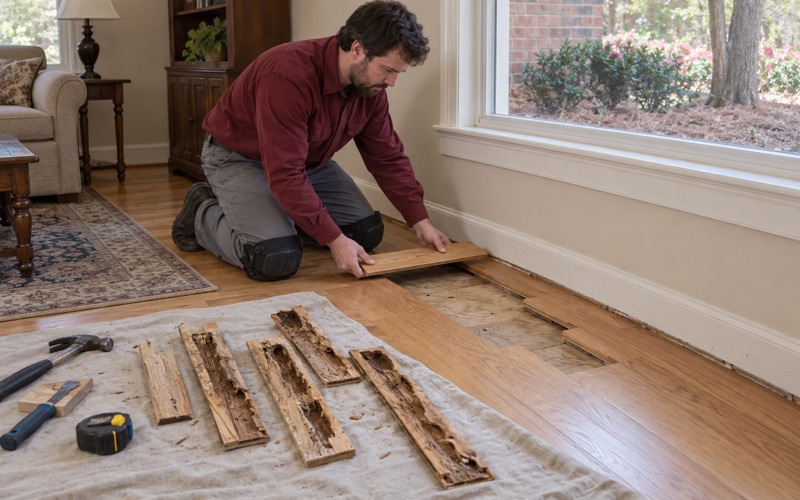
In any old wood-frame house, we watch for signs of subterranean termites, such as mud tubes along a baseboard or sill or termite swarmers in spring, and for the small holes powderpost beetles leave. We do not treat pests ourselves. We point out what we see so the pest control company can treat before any board comes out.
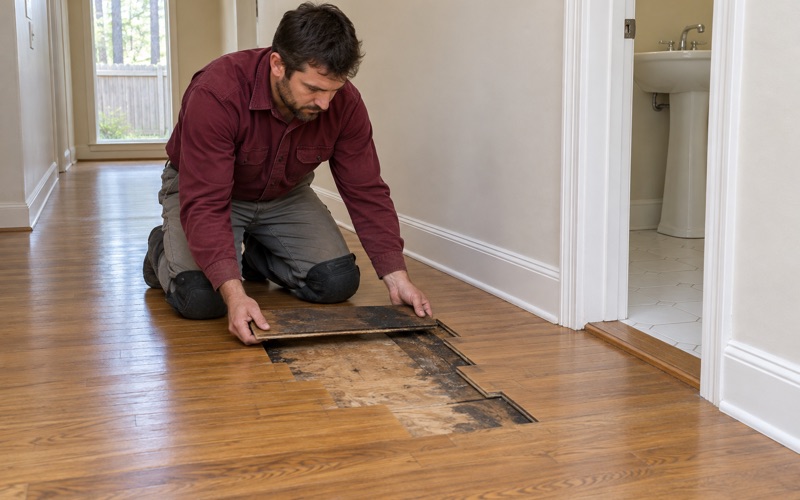
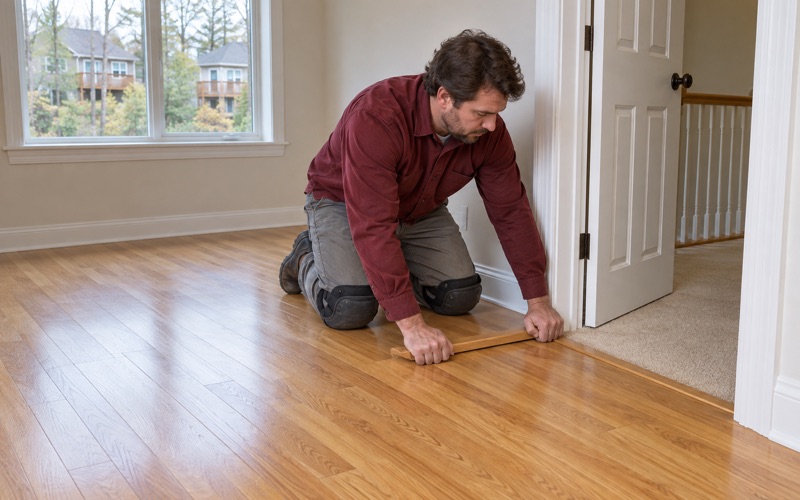
Where a board is split, rotted at a threshold or damaged by subterranean termites, we cut it out and weave in replacement stock once the pest control company has finished its treatment. New boards are matched to the color the old floor has aged to, not to a catalog sample, so the repair reads as part of the room when the finish goes down.
Old floors are refinished for what they are. A floor this age carries patina, small gaps and wear that a new floor does not, and trying to sand all of it away usually costs wood the floor cannot spare. We aim for a sound, even finish that still lets the age of the boards show.
A Granite Exception
Not every historic house here is wood. The nomination describes the 1907 Edward Buchanan house at 98 Buchanan Street as a two-story, finely detailed French Provincial-period house fashioned from granite blocks. It is a reminder that the district is varied, and that every house gets looked at on its own terms before a plan is written.
Victorian Cottages and Craftsman Bungalows
L- and T-Plan Cottages Southeast of the Center
The smaller end of the district is just as much a part of its story. Southeast of the commercial center, the nomination records modest one-story, wood-framed Victorian cottages with L- and T-shaped plans, and elsewhere simple one-story, gable-roofed, weatherboarded cottages. These are compact houses, and their floors often run through several rooms with little break between them.
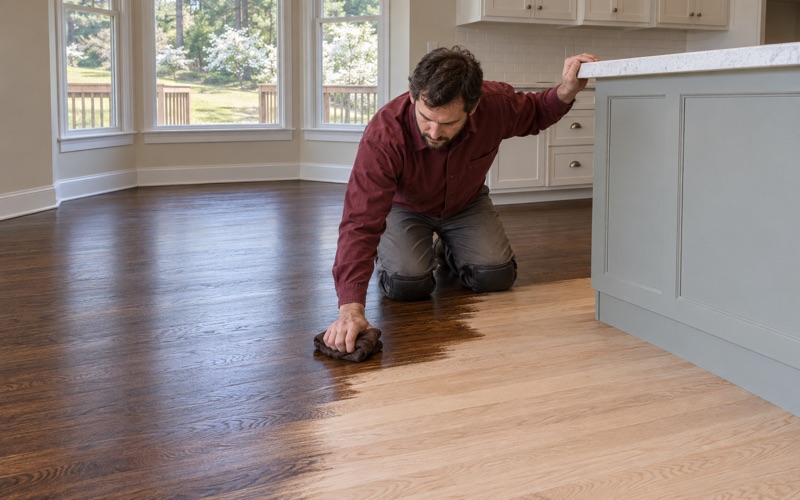
In a cottage, one refinish can cover most of the living space, so a stain color carries across the whole house. That is why we lay samples on the actual floor and leave them to be seen in morning and evening light. Old boards take stain unevenly, and a sample on the real wood is the only honest preview.
Bungalows Near Academy Street
Near Lawrenceville, Academy and Rakestraw streets, the nomination describes early-twentieth-century houses, including modest period houses and Craftsman-style bungalows. They are a generation younger than the Victorian houses, and their floors may already have been refinished several times, or covered with carpet for decades and uncovered later.
When carpet comes up in a house like this, we pull the tack strip and carpet pad carefully and look at what they left behind: staple holes, pad residue, water stains and pet urine stains. Some of it sands out and some calls for board replacement, and we tell you which before a quote is final.
Stairs in Two-Story Houses
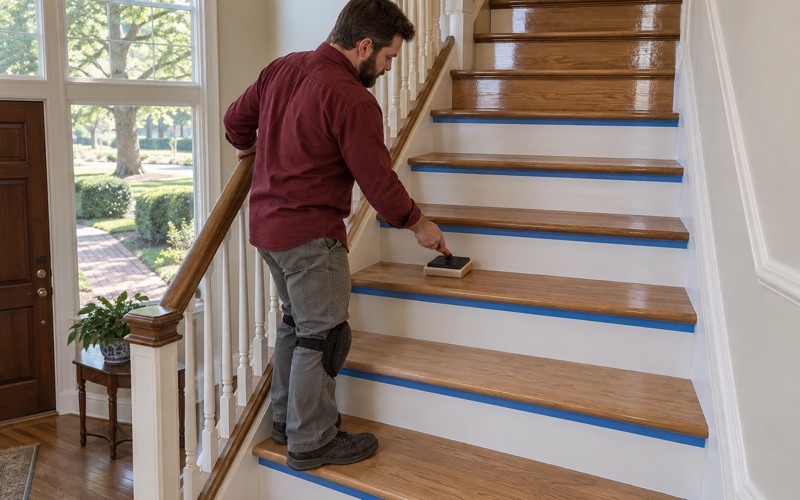
Two-story houses bring stairs, and stairs are their own job. We quote treads one by one, separating the ones that can be refinished from the ones that need new treads, risers or nosing. On an old staircase the nosing profile may not match anything stocked today, so new pieces are shaped to match what is already there.
Landings and the hallway boards at the top of a stair take the heaviest traffic in a two-story house, and they often show the worst traffic lanes. We blend refinished stairs into the upstairs floor so the color and sheen run continuously rather than stopping at the last tread.
Refinishing Norcross’s Oldest Floors
Checking the Wood Before Sanding
A house built before 1940 has almost certainly been sanded before, and every sanding removes wood from above the tongue. Before we commit to a full refinish, we check how much remains at a floor register or an edge where a board can be seen in section. If little is left, a screen and recoat or a targeted repair may serve the floor better.
We also check the build year and the painted surfaces, because older houses may carry lead-based paint on trim, baseboards and shoe molding that sit right against the floor. Work that disturbs those surfaces is planned around that possibility from the start rather than discovered halfway through a sanding job.
Moisture and Movement
Wood-frame houses move with the seasons. Board gapping that opens in winter and closes in summer is normal for old strip floors and does not call for filler in every seam. We read the gaps against the season before deciding which ones need attention, and which are simply the house breathing.
Real moisture trouble looks different. Soft spots, a musty smell or boards that feel hollow underfoot send us below the surface, and we open the floor to trace the cause to the subfloor or the water behind it. Once the source is fixed and the wood has dried back to normal readings, repairs and refinishing can go ahead.
Sanding and Finishing
Dustless sanding keeps most of the fine dust out of the rest of the house, which matters in a small cottage where there is little room to move furniture. We work through a grit sequence suited to the wood’s condition, and water popping before stain helps old boards take color more evenly.
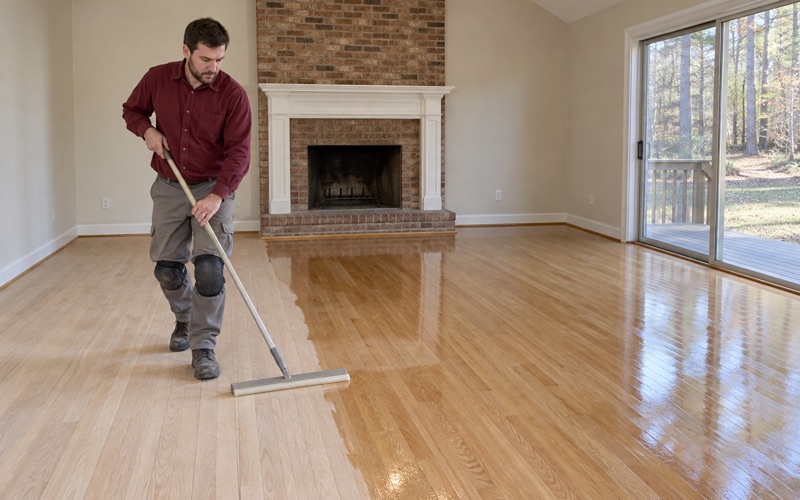
For the finish, we talk through waterborne polyurethane, oil-modified polyurethane and hardwax oil, and what each does to the color of older wood. Oil-modified finishes deepen and warm the tone, while waterborne finishes stay clearer. Sheen level matters too, since a lower sheen hides the small irregularities an old floor will always have.
Newer Floors in the Rest of the City
Most Norcross homes date from the 1980s onward, and their site-finished red oak and white oak can often be sanded and refinished rather than torn out, once we confirm the wood left above the tongue. Orange oak from an aging finish can be brought back toward a neutral tone. Where a homeowners association governs the property, we confirm its written approval first, since any interior flooring rule comes from your own declaration.
Traffic lanes, sun fade under a west window and furniture scratches are the usual complaints in these homes. Light wear often needs only a screen and recoat, while deeper damage calls for a full sand. We tell you which the floor needs, not which is the bigger job.
When a termite letter or inspection turns up damaged flooring ahead of a sale, in an old cottage or a newer townhome, we work with sellers against the closing date. Damaged boards come out and matched stock is woven back in after treatment, so the floor reads as one surface again by the buyer’s walk-through.
- 20+ Years on Wood Floors
- Moisture Read Before Sanding
- Stain Samples on Your Floor