Roswell Wood Flooring brings more than 20 years of work to wood-flooring in North Druid Hills, from sanding and refinishing to board replacement, stairs and new hardwood installs. We start every job by reading the floor: where it cups, where it feels soft underfoot, where the finish has worn through in traffic lanes, and what that pattern says about the house beneath it.
Most calls we take here fall into a few groups. Some owners want a tired site-finished oak floor sanded back to bare wood and given a fresh color. Others have carpet, a parquet foyer or builder-grade flooring they are ready to trade for solid hardwood. A third group is dealing with damage, whether from a leaking supply line, a dishwasher or a termite finding that turned up during a sale.
Whichever group you fall into, the plan is written after we measure, not before. Moisture readings, board-by-board checks and a look at the subfloor tell us whether a floor needs a screen and recoat, a full sand, a repair or a replacement, and we explain the difference in plain terms before anything is quoted.
DeKalb County Parkland Inside North Druid Hills
A Community DeKalb County Governs
North Druid Hills is an unincorporated community and census-designated place in DeKalb County, and it has no city government of its own. Proposals to form a City of Briarcliff in 2014 and a City of LaVista Hills in 2015 both failed, so zoning, permits and code enforcement here run through DeKalb County rather than a city hall.
For a flooring project, that shapes who answers the questions. If a larger renovation raises something the county regulates, the answer comes from DeKalb County offices, and we send you there rather than guessing. Interior floor work in a condominium or townhome carries a second layer, the association, which we cover further down.
Wooded Public Land Inside the CDP
What sets this part of DeKalb apart for us is that wooded county parkland sits within the community’s own boundary. DeKalb County’s park inventory, dated February 2025, counts 113 park sites across 1,728.50 acres countywide, and two of the wooded ones carry addresses that the Census geocoder places inside the North Druid Hills CDP.
Those are W. D. Thomson Park at 1760 Mason Mill Road and Kittredge Park on Kittredge Park Road, which adjoins the Elwyn John Wildlife Sanctuary. The inventory lists other parks with the same 30329 ZIP code, including Margaret Harris Park and Briarcliff park, but their placement inside the CDP was not confirmed, so we leave them aside.
Why the Parks Frame Our Work
We are not flooring the parks, of course. The work happens in the ranch houses, townhomes and condominiums on the streets around them, and the parkland is simply a useful landmark for describing where those homes sit.
The community’s commercial center is the Toco Hill Shopping Center near North Druid Hills Road and LaVista Road, and the homes we visit sit on the residential streets beyond it. We plan parking, dust containment and material staging for each address before the first day rather than improvising at the curb.
Looking for wood-flooring closer to Smyrna? See Wood-Flooring Services in Smyrna.
W. D. Thomson Park and the Mason Mill Road Area
A 29-Acre County Park
DeKalb County lists W. D. Thomson Park at 29.0 acres on Mason Mill Road, a sizable piece of woods for a community with just under 4 square miles of land. Published trail guides describe about 2 miles of trails there and place the park along South Fork Peachtree Creek, though that creek detail comes from secondary sources rather than a county record.
We do not have a street-by-street housing count for the Mason Mill Road area, but the figures for the CDP as a whole explain much of what we find on floors near the park. We treat them as a starting point, then let each house correct them.
Houses From the 1950s and 1960s
Census estimates count 10,052 housing units in North Druid Hills, and 27.8 percent of them were built in the 1950s and 1960s. Among owner-occupied homes, 61.1 percent are detached houses, so many of the owners who call us about refinishing live in a freestanding house rather than a shared building.
In houses of that age we check the build year and look for painted surfaces before any sanding starts, because older paint on baseboards, stair risers and trim needs careful handling. We also avoid assuming what is under the carpet. The floor tells us its species and history when we pull back a corner, not before.
The 1980s Oak Floors
The single largest build decade here is the 1980s, at 24.2 percent of units. When a house from that era or the 1990s has site-finished red oak, the floor has often gone orange with age, worn gray in the traffic lanes, or picked up water stains near the kitchen.
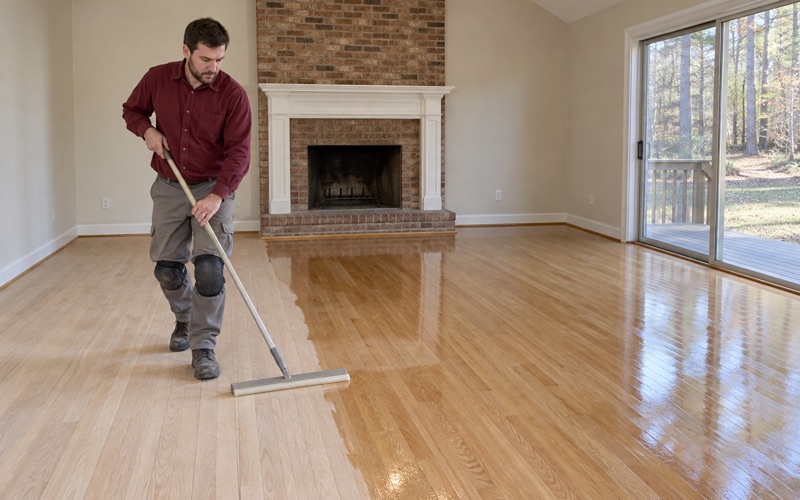
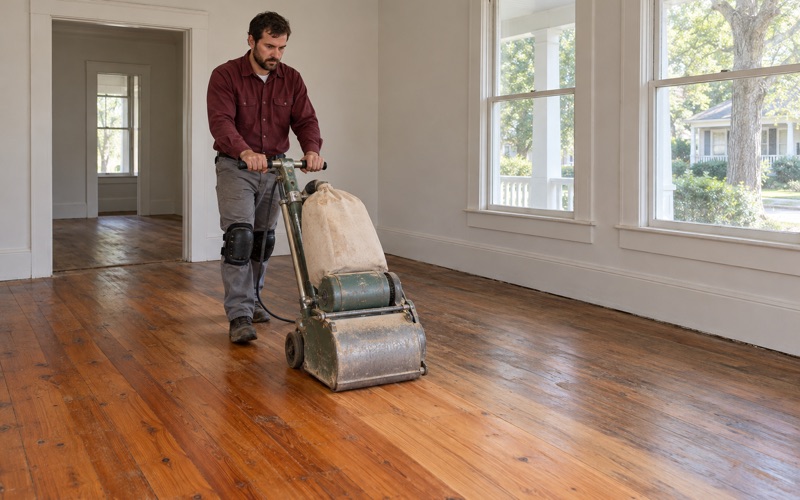
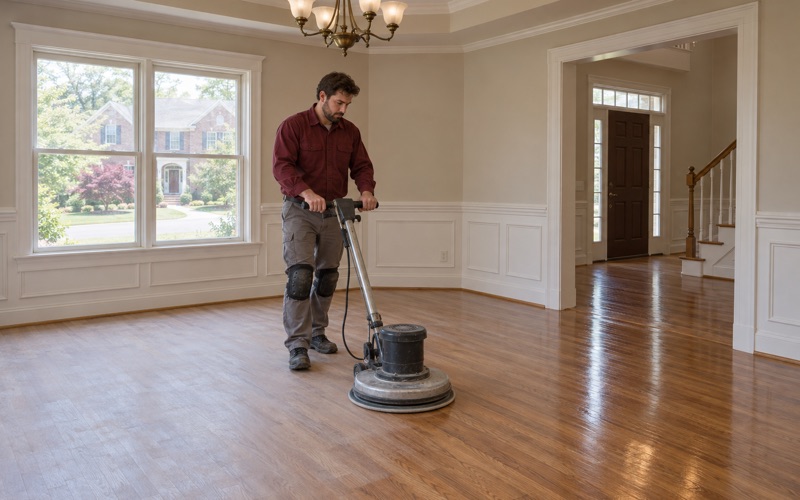
Those floors are usually worth keeping. Before recommending a full sand, we check how much wood remains above the tongue, because each drum sander pass removes some of it. If there is enough, we run a proper grit sequence, finish with the orbital sander, and apply waterborne or oil-modified polyurethane at the sheen level you choose.
Kittredge Park and the Elwyn John Wildlife Sanctuary
Around Kittredge Park Road
Kittredge Park sits on Kittredge Park Road, with the Elwyn John Wildlife Sanctuary adjoining it. Trail guides describe the sanctuary as about 29 acres with roughly 1.5 miles of trails.
Condominium owners in the community often call about parquet foyers, worn prefinished floors, or boards that have gapped near an exterior wall. Some board gapping in winter is normal, and we measure it across seasons before recommending anything more than a careful refinish.
Parquet deserves its own note. A loose parquet tile or a lifted block in a foyer can usually be reset or replaced without disturbing the rest of the pattern, while a floor that is failing across the room is a candidate for replacement with hardwood or a herringbone layout.
A Community That Mostly Rents
North Druid Hills has more renters than owners. Of 8,333 occupied homes, 58.4 percent are rented, and most of those rented homes are in buildings of five or more units. That shapes our scheduling, since a floor in a larger building often has a neighbor below, shared hallways and building rules about work hours.
When the owner is a landlord or a condo investor, we coordinate access with the tenant and keep the owner informed with photos and readings. Pet urine stains, sun fade and deep scratches are common between tenancies, and we price board replacement against a full refinish so the owner can compare.
Association Approval Before Work Begins
In a townhome or condominium, any rule about interior flooring comes from your own declaration and the association’s written policies. The Georgia Condominium Act and the Georgia Property Owners’ Association Act set the framework, but the specific requirement lives in your documents, so we confirm the association’s written approval before we schedule.
That approval can reach the product itself. Some documents address underlayment or flooring type, and a glue-down engineered floor, a floating floor or luxury vinyl plank may be what a building allows. We match our recommendation to what your documents say rather than to what we would install elsewhere.
Floors in the Houses and Condos Around the Parks
Cupping, Crowning and Humid Summers
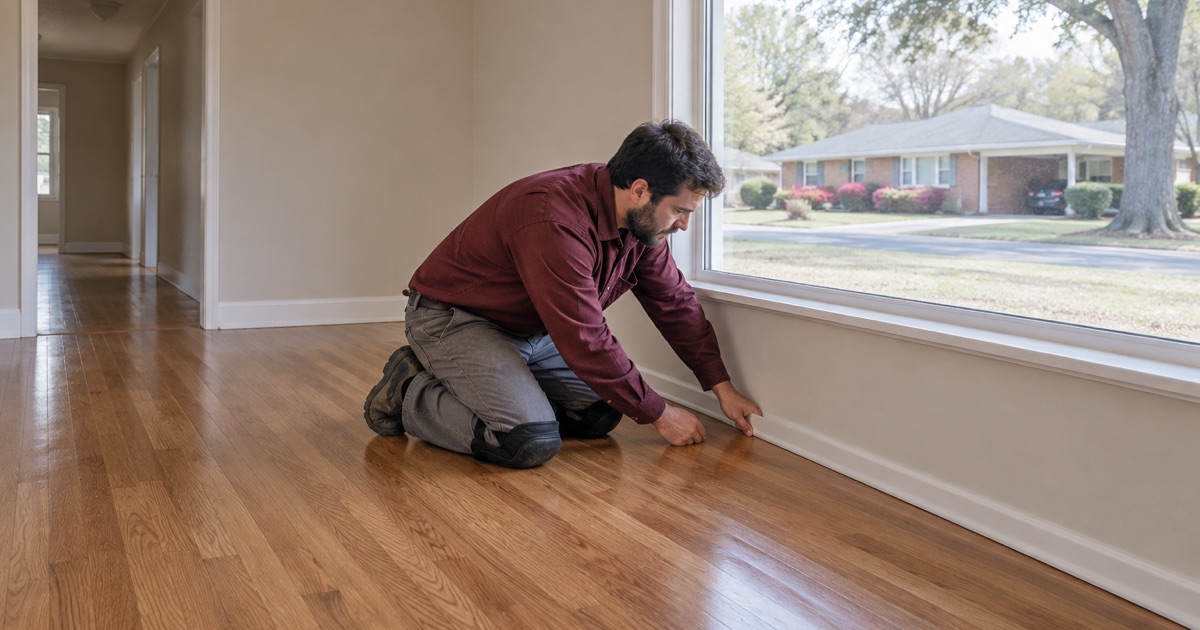
Georgia humidity shows up in the floor. When boards cup or a room feels clammy in summer, we read the wood with a moisture meter and find the source before anyone talks about sanding. Sanding a cupped floor flat while it is still wet leaves it crowned once it dries.
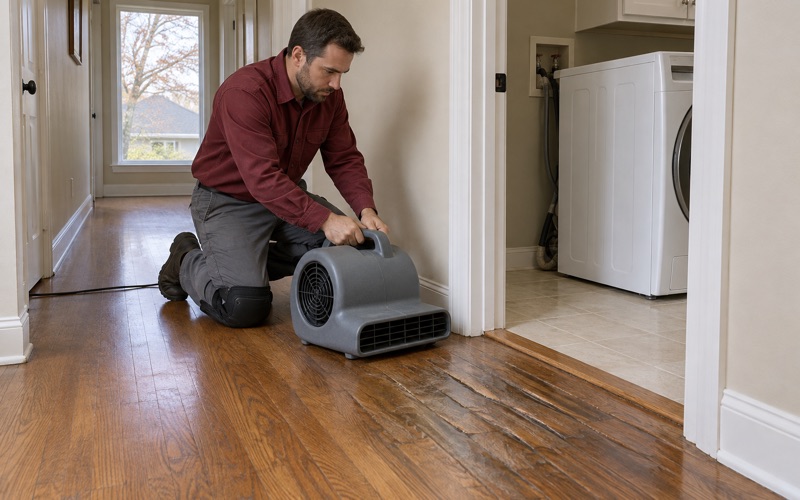
The same approach applies to water from a washer, dishwasher, supply line or storm. We trace it, dry it with dehumidifiers, and measure again before replacing boards, then document each room for your adjuster so the claim reflects what actually happened.
Soft Spots and Termite Damage
A spongy floor or a hollow spot near a doorway gets opened up and traced to the subfloor, the joist or the moisture behind it. We do not screw a soft area down and cover it, because the cause stays in place and the problem returns.
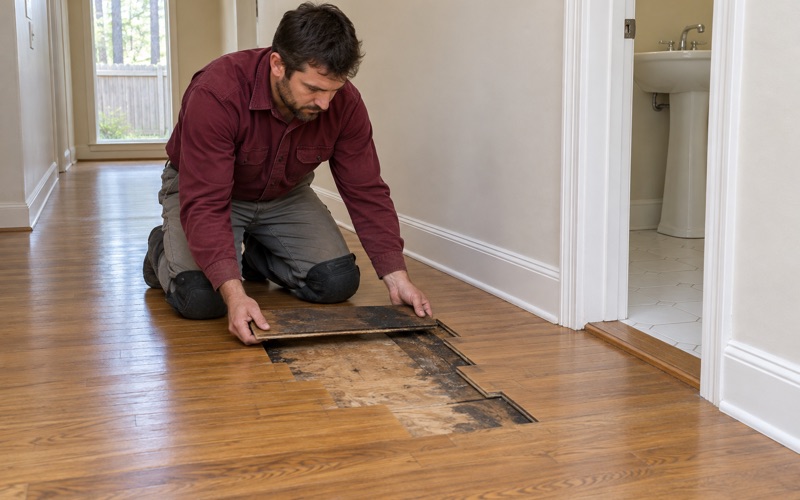
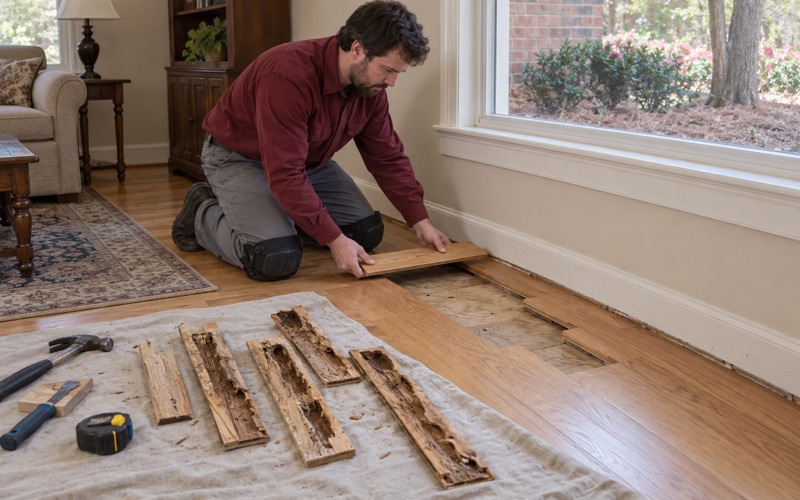
Subterranean termites are the other common find, often signaled by mud tubes or termite swarmers in spring. After your pest control company treats, we cut out the damaged boards and weave in matching stock. If a termite letter or an Official Georgia Wood Infestation Inspection Report turns up damage ahead of a closing date, we work to that date.
Engineered Floors Below Grade
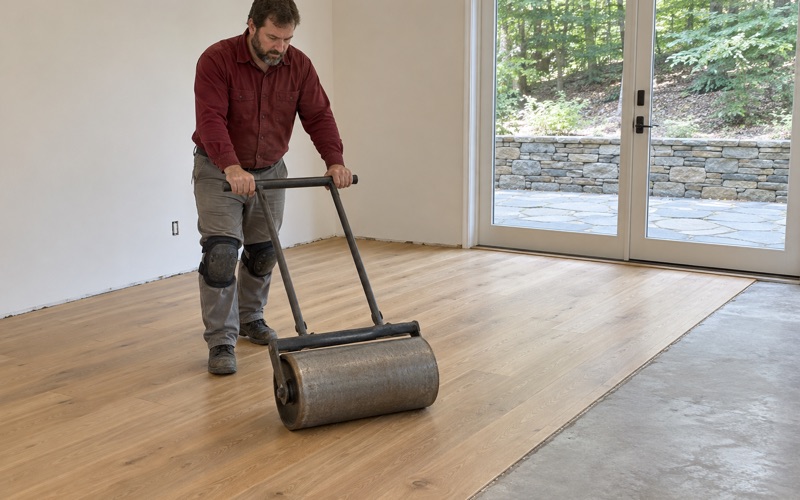
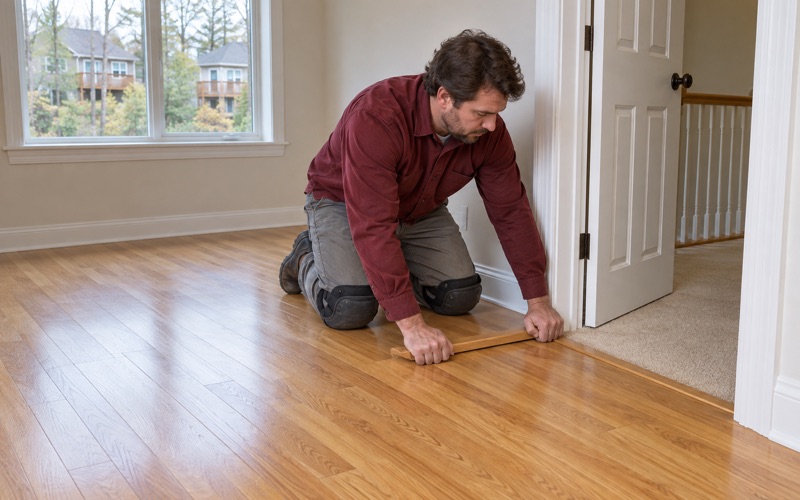
Where a room sits below grade, solid hardwood does not belong, and we match an engineered floor with a suitable engineered wear layer to the space instead. We test concrete moisture to ASTM F2170 where the job calls for it, follow the NWFA Installation Guidelines, and leave the proper expansion gap at every wall.
Acclimation matters just as much for solid wood upstairs. New flooring sits in the home long enough to approach the moisture level of the rooms it will serve, and we log those readings so a later question about cupping or gaps has a record behind it.
Stairs, Carpet and Choosing a Color
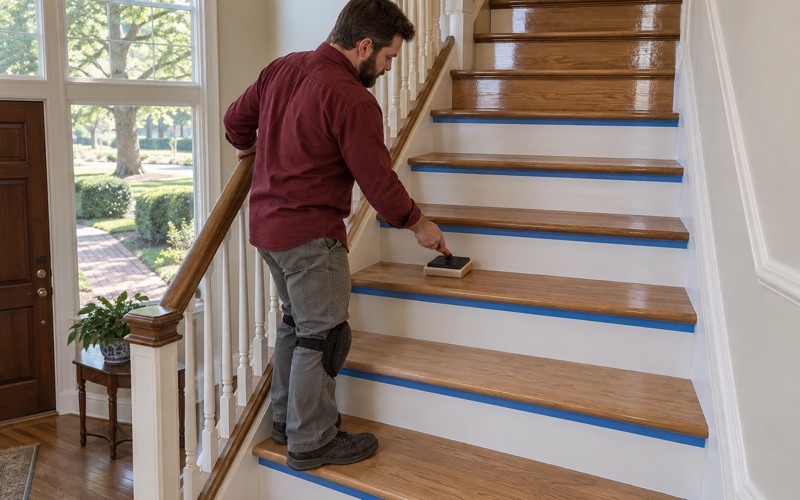
Plenty of homes still have carpet on the stairs and landings. We replace the carpet, carpet pad and tack strip with hardwood, and we price stairs tread by tread, keeping refinishing existing treads and installing new stair treads with fresh nosing as two separate line items.
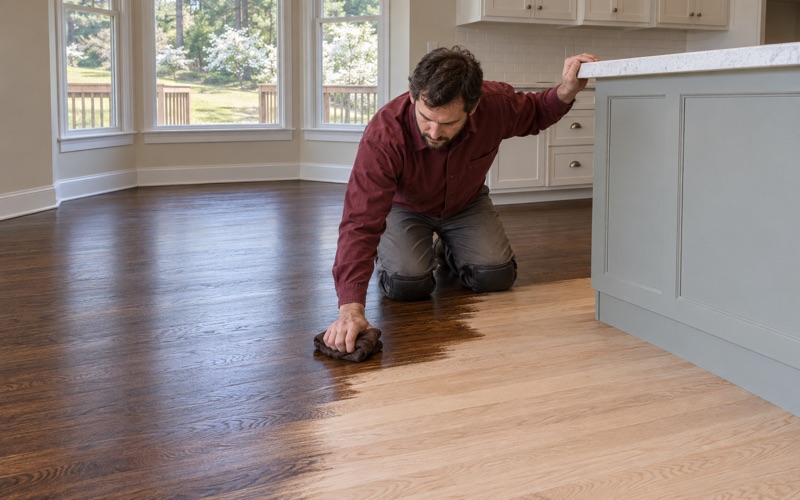
Before a stain is chosen, we lay stain samples on your own floor so you can see them in your own light, morning and evening. Red oak, white oak and heart pine each take color differently, and a sample on the actual boards is the only reliable preview.
- 20+ Years on Wood Floors
- Moisture Read Before Sanding
- Stain Samples on Your Floor